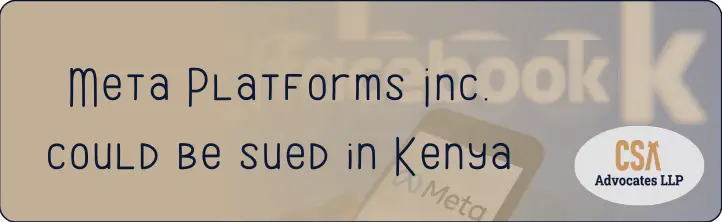
Commentary on the Landmark Lawsuit In Kenya
Over Content Allegedly Inciting Ethnic Violence During the Tigray Civil War and Meta Platforms Inc (Facebook)
Drafted by Kennedy Lutukai for CSA Advocates LLP.
- Date: 11th April 2025
- Jurisdiction: High Court of Milimani
- Case: Katiba Institute & Others v. Meta Platforms Inc. by Hon. Justice John Mativo
Introduction
In a significant legal development in April 2025, the High Court of Kenya sitting at Milimani under the guidance of Hon. Justice John Mativo ruled that Meta Platforms Inc. (Facebook’s parent company) could be sued in Kenya for its alleged role in facilitating and amplifying content that incited ethnic violence during Ethiopia’s Tigray civil war (2020–2022).
This case marks a pivotal moment in the evolving landscape of digital accountability, as it raises fundamental issues surrounding the responsibilities of tech companies in moderating content, the jurisdictional reach of Kenyan courts, and the broader implications of cross-border legal actions.
Background of the Case
The lawsuit, initiated by Ethiopian nationals Abrham Meareg and Fisseha Tekle, along with the Kenyan civil society organization Katiba Institute, accuses Meta of amplifying harmful and hateful content that contributed to violence during the Tigray conflict. From the court documents, the plaintiffs asserted that Facebook’s algorithm promoted violent posts and incited ethnic hatred, resulting in real-world harm, including the murder of Meareg’s father. This legal action seeks both compensation for victims and a systemic overhaul of Meta’s content moderation practices.
The case raises the critical issue of whether a global tech company can be held accountable in a jurisdiction outside its home country, especially for actions that indirectly lead to harm in another nation.
Key Legal Issues at Stake
Jurisdiction Over Multinational Tech Firms
The Hon. Justice John Mativo ruled that Meta could be sued in Kenya, despite its headquarters being located in the United States. The court found that Meta’s significant commercial and operational presence in Kenya—including content moderation hubs—created a sufficient nexus for Kenyan jurisdiction.
This ruling reinforces the principle that companies operating within a country must comply with that nation’s laws, especially when their activities can affect local citizens.
Duty of Care in the Digital Age
A central aspect of the plaintiffs’ claims is that Meta failed in its duty of care by allowing its platform to be used for the dissemination of harmful and incendiary content.
The court will have to decide whether Meta, as the owner of the platform, had a legal obligation to prevent the spread of content that could contribute to violence or harm in politically unstable regions, especially given the complexity of algorithmic amplification.
Legal Frameworks at Play
The Constitution of Kenya, 2010
Article 2(5) & 2(6): Kenya’s Constitution incorporates international law and treaties, which could include the UN Guiding Principles on Business and Human Rights (UNGPs), creating a foundation for holding multinational corporations accountable.
Article 23:Provides for the enforcement of constitutional rights, including the right to access justice for violations of fundamental freedoms.
Articles 28 & 29: Protects an individual’s right to dignity, as well as freedom from cruel, inhuman, or degrading treatment—principles that may be invoked to argue for compensation for harm caused by online content.
The Computer Misuse and Cybercrimes Act, 2018
Sections 27 and 28 of this Act criminalize the publication of false, misleading, or harmful information, which could include hate speech and content that incites violence.
The Act provides the legal framework to challenge the promotion of harmful content by digital platforms, particularly if such content facilitates violence or discrimination.
Lorem ipsum dolor sit amet, consectetur adipiscing elit. Ut elit tellus, luctus nec ullamcorper mattis, pulvinar dapibus leo.
The Data Protection Act, 2019
Meta’s handling of personal data and its use for content targeting could also fall under scrutiny under Kenya’s Data Protection Act. If data misuse or violation of privacy is tied to the promotion of harmful content, the company may be liable for breaching individuals’ privacy rights.
International Law
The UN Guiding Principles on Business and Human Rights (UNGPs) establish that businesses, including tech giants, have a responsibility to respect human rights and avoid contributing to human rights violations.
The Rome Statute of the International Criminal Court (ICC) also indirectly informs discussions on corporate complicity in mass violence, even though it is not directly invoked in this case.
My Take
The Hon. Justice John Mativo ruling to allow the lawsuit against Meta to proceed is a landmark ruling that could have wide-reaching implications for both tech regulation and international human rights law. The case challenges the boundaries of accountability for global tech companies and signals a shift towards more robust legal frameworks to address the complex issues surrounding content moderation, algorithmic amplification, and digital responsibility.
This case will likely continue to develop and could set an important precedent for how other nations, particularly those in the Global South, approach tech company accountability in the digital age. As the world increasingly navigates the intersection of digital platforms and human rights, this case is likely to be a key moment in shaping the future of global tech governance.
Prepared by Kennedy Lutukai for CSA Advocates LLP
Your trusted legal partner in navigating the complexities of international and digital law.
Our Practice Areas
Date of Adoption: 28/02/2024
CSA ADVOCATES LLP
Start, Grow, Protect Your Business